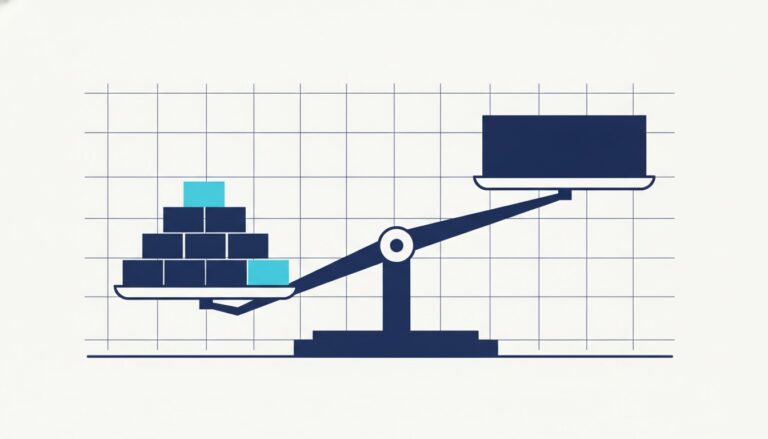
What happens to your assets when an exchange fails
The outcome is decided by legal structure long before any failure, and almost never by the technology. What determines whether customers are made whole.

Whether you get your assets back after a custodian fails is determined almost entirely by arrangements made before anything went wrong. It is a legal question, not a technical one, and the answers are usually available in advance to anyone who reads for them.
Deposit and you become a creditor
The starting point people find most surprising. When you deposit into a custodial exchange, in most arrangements you no longer own specific assets. You hold a claim against the company for a balance, and the company holds the assets.
The practical difference appears only at insolvency. An owner of segregated property can generally claim that property back. A creditor joins a queue and receives a proportion of whatever remains after those ranking above them are paid. The same balance on the same screen can mean either, depending on terms you agreed at sign-up.
Segregation, and whether it is real
Segregation means customer assets are held separately from the company’s own and are not used to fund its operations. Where it is genuine and legally effective, customer assets may sit outside the insolvency estate entirely.
Two things undermine it in practice. The first is commingling: assets nominally segregated but operationally pooled, so no individual holding can be identified. The second is rehypothecation — terms permitting the custodian to lend or pledge customer assets, which converts your property into someone else’s collateral with your consent.
Both are addressed in terms of service, generally in a section about the use of digital assets. It is not compelling reading and it is the section that decides the outcome.
Which entity actually owes you
Large exchanges are corporate groups, not single companies. The entity named in the terms you accepted may be different from the one holding the assets, and different again from the one that markets the service.
This determines which insolvency regime applies, which court, and which creditor hierarchy. Customers of different entities within the same brand can experience very different outcomes from the same collapse. The name at the top of the terms of service is the one that matters, and it is frequently registered somewhere other than where you live.
Where a claim ranks
Assuming you are a creditor rather than an owner, ranking decides everything. Secured creditors are paid first, then various preferential classes depending on jurisdiction, then unsecured creditors — which is usually where customers sit.
Two consequences follow. Recovery is a proportion rather than all-or-nothing, and it takes years. Claims are also commonly valued in fiat at the date proceedings opened, so subsequent price movement in the asset does not accrue to you. Recovering a percentage of a valuation fixed at the worst moment is a materially different outcome from recovering your coins.
What insurance usually covers
Exchanges advertise insurance, and it is worth knowing what these policies typically address. They generally cover theft from the custodian’s own hot or cold storage — a security event.
They typically do not cover insolvency, mismanagement, fraud by the operator, unauthorised access to your individual account through your own credentials, or losses arising from the custodian’s business failing. Deposit insurance of the kind attached to bank accounts in many jurisdictions generally does not extend to crypto balances, even where the same institution offers both.
What to check, and what it costs
Four things, all findable before you deposit: which legal entity is named in the terms; whether assets are segregated and whether the terms permit lending or pledging them; what regulatory registration the entity holds and what that registration actually requires; and what any advertised insurance covers.
None of this makes an exchange unusable, and holding assets on one is a reasonable choice for many purposes. The point is that the choice carries a specific, knowable exposure that is settled by paperwork rather than by technology — and that the alternative, self-custody, replaces it with a different exposure rather than removing risk. Our comparison of who actually holds your crypto sets both sides out.
Warning signs that appear before a failure
Collapses are usually sudden in public and gradual in fact. Several signs tend to precede them and are visible without inside information.
Withdrawal friction is the clearest: delays described as upgrades, new limits, additional verification imposed on withdrawal but not deposit. A custodian short of assets slows the outflow before it stops it.
Others are structural. Yields materially above what the market offers have to come from somewhere, and the usual somewhere is lending customer assets or paying from capital. Ownership or corporate structure that is hard to establish, an auditor that resigns, an unexplained departure of a finance officer, or a sudden marketing push funding growth during a downturn all belong on the list.
None is conclusive alone. Several together have preceded enough failures to be worth treating as a prompt to reduce exposure rather than a puzzle to solve.
Proof of reserves does not answer this
Worth connecting explicitly, because the two topics are frequently conflated. A proof of reserves demonstrates assets at a moment. Solvency depends on assets against liabilities, and recovery depends on legal structure.
A custodian can publish a clean proof and still fail, and its customers can still rank as unsecured creditors afterwards. The proof was never addressed to that question. Our note on what proof of reserves demonstrates covers the boundary in detail.
Reducing exposure without abandoning exchanges
The practical position for most people is not to avoid custodians but to be deliberate about how much sits with them and for how long.
Balances needed for trading are a working requirement. Balances sitting idle for months are a decision, and one worth making explicitly rather than by inertia. Spreading across more than one custodian reduces single-entity exposure at the cost of more accounts to secure. Moving longer-term holdings to self-custody removes the counterparty entirely and substitutes the risks covered in our note on what hardware wallets protect against.
There is no arrangement without exposure. What there is, is a choice about which kind you hold — and that choice is better made while everything is working than during a withdrawal queue.